Archive 04 — Artist
From image to material
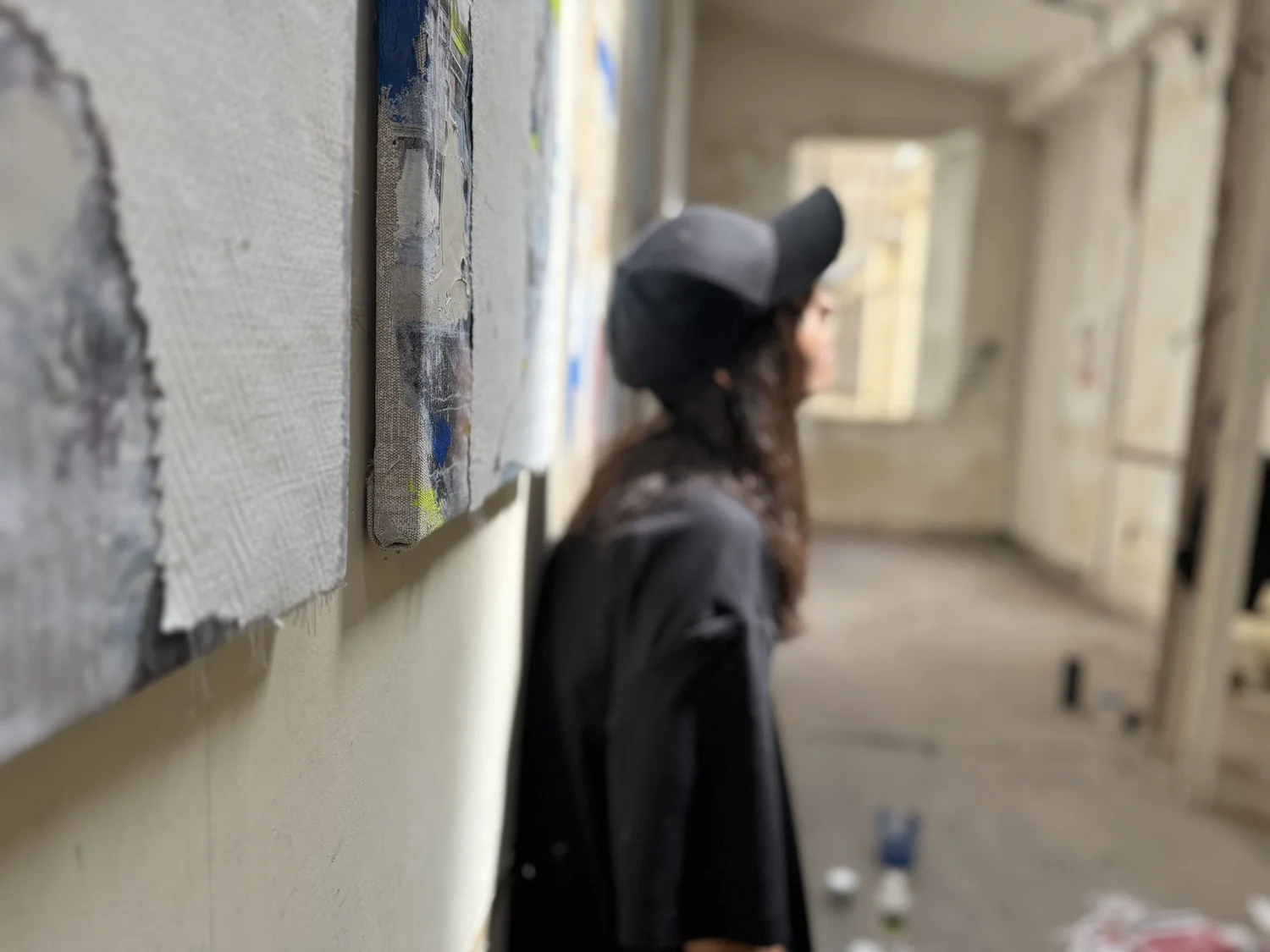
Sandrine Rose Abessera was born in Paris to parents of French Moroccan heritage. A graduate of ESMOD, she worked as creative director for fashion brands, including her own, before devoting the last fifteen years to her studio practice.
Her process begins with photographs taken while travelling. She deconstructs and rephotographs these images in layers, printing on wood, linen and canvas before adding paint, tape and pastel. The work brings memory, movement and material into a single changing surface.
Contact the studioCritical essay — by Tom Teicholz
Sandrine Rose Abessera: Art in Conversation with Time and Place
When she was 12 years old, growing up in Paris, Sandrine Rose Abessera's mother took her to see a child therapist, concerned that her daughter was anxious and overly agitated. The therapist decided that an office was not most conducive to their conversations. Instead, each week she took Sandrine to an art museum, where they talked not about her but about the paintings and what she saw in them. In some ways it was like a Rorschach but, more importantly, it set the foundation for Abessera's artistic practice, which is multi-media, multi-disciplinary and is, in the end, a conversation about what she sees in the world.
Sandrine's work exists first as unique original assemblages made from a variety of media, including photographs from her travels that have been deconstructed and rephotographed, layer upon layer, and composed in terms of shapes, forms and color, as if her photographs were themselves brushstrokes and printed on different papers and surfaces. Then other elements are added including color, spray paint, oil, even, on occasion, bits of wallpaper. Once finished, the original assemblages which can be sculptural, are themselves photographed and become part of a series, each inspired by a place, a feeling, a secret meaning.
By the strange alchemy of Sandrine's eye and her talent, the works convey emotion, wit, intelligence and provokes one's recall of childhood moments, and of travel where the past is present, and the present is a jumble of reminiscences, dreams, and associations. Looking at her work, the mind searches to create its own narrative, its own meaning. In each work, it is as if Sandrine is writing an essay using images instead of words. She is telling her story.
Sandrine Rose Abessera was born in Paris in 1977 to parents of French Moroccan heritage. She had a conventional French education studying at a Lycée, getting her baccalaureate, and then attending University, studying Economics and Business. But after two years, she switched to Paris' top fashion school ESMOD – and it was there that her artistic conversation began.
To set this in context, in France fashion designers have long been considered artists and many have had careers as artists as well, whether it was Yves St. Laurent, Sonia Rykiel, Agnes. B. or Karl Lagerfeld.
While still in school, Sandrine launched her own streetwear fashion brand MU, which was woman-focused and artistic in nature. This launched Sandrine in the fashion world where over the next fifteen years, while making Art for herself, she became a creative designer at popular fashion brands such as Guess, Marciano, BCBG, and Koral. Sandrine created the story of each collection, setting the themes and working with the photographers to deliver the brand's creative vision. Then, some seven years ago she decided to create her own jeans brand, Sandrine Rose.
"Denim was very interesting," Sandrine said recently, "Because you see a raw fabric and the question is: What are you going to do with it?"
Sandrine described her brand to Vogue in ways that could very much describe her current artistic practice: “It’s the outcome of all the different media I’ve worked with over the years—photography, painting, the vintage I’ve collected while traveling, handcraft and textiles from different cultures,” The brand was carried by high-end designer-driven fashion stores like Colette in Paris and Barney's in New York. However, after production was halted during the pandemic once for Covid, the second time due to the War in Ukraine, the owners decided to discontinue the brand.
Sandrine decided this was the opportunity of a lifetime to devote herself to her Art. During her travels, Sandrine had always taken her camera, photographing whatever caught her eye – often not people but landscape, walls, little details that resonated.
Back in her studio, Sandrine would print a lot of the photos, sometimes as many as 50 at a time. She would then rework the images, engaging in a rigorous process of editing and composition, adding external elements such as other photos, spray paint, oils or pastels, and deciding on different materials on which to print and finalize the work.
In her Art, Sandrine negotiates the elements of empty space, color combinations, and textures, in a visual language and aesthetic that is uniquely hers. Drawing from a wide range of influences, from the Polish School of Posters to the way Paris metro posters pile on top of each other, as well as being inspired by old apartments where you peel away the wallpaper to find older wallpaper beneath. For Sandrine, the past found, the past regained, and how it manifests in the present are all areas for her artistic inquiry.
Sandrine’s art is part mystery, part chance, and all instinct. She begins the work not knowing what the result will be, just confident that she will arrive there. The materiality of her work is important, not only as part of her process, but as personal triggers.
Each of Sandrine's series reveals different aspects of her work and its influences. In Layers of Memory, images are rigorously taken apart and layered back together in ways that are surprising and compelling, in the spirit of a Kurt Schwitters Merz Construction.
Regarding her work, Soul of Forms (2022), Sandrine wrote, “We do not see the real. Because our mind is not ready for it.” Looking at this work, our mind at the same time wants to reorganize the fragments but knows it’s not possible. Yet there is something pleasing about this reassembled dichotomy that we recognize as an artwork. Sandrine explains further “Accepting those blocks as one will allow us to find peace. Pain is the price of pleasure and pleasure is the reward of pain. Beyond pain and pleasure there is bliss.” It is the very contradiction of the image’s disruption that makes Sandrine’s work so satisfying.
In making the work, Sandrine filters through the images, processing layers of memory. There is no conscious message, no intention beyond creation. To Sandine, in assembling the images like words, the result must be poetry.
In Sandrine's work one also sees the influence of DADA and the French surrealists, with their automatic writing and exquisite corpses and art of the readymade and of the moment.
The Surreal and real, the imagined and the seen coexist in her work.
Take for example her work, Untitled (2023). A doorway beckons. Is it a doorway to the street? Or are in the street? We seem to be in a courtyard – there is a basketball hoop on the wall – all this we understand but there in the courtyard there is an apparition, as if a Pieta wheatpasted to the wall has come off and its pieces are falling, floating in the entryway. Of this work, Sandrine wrote, “a glimpse of life in one vision. A year, a trip, a story or sometime just a dream...If only we could express our thoughts in one frame... Can art speak with deeper meaning than words can express?”
Sandrine's work is part of a tradition of artists such as Keith Haring and Jean-Michel Basquiat who first found inspiration in the street rather than the academy, the gallery, and the museum. At the same time, her use of photography and her ability to deconstruct and construct images recalls the photographic compositions of David Hockney most famously in his Pearlblossom Highway. Finally, Sandrine uses her images much as conceptual artists such as Jenny Holzer and Stefan Brüggemann use words in their work. Sandrine is painting with images, adding and subtracting from those images and adding other elements in ways that remain personal to her, yet communicate emotionally to the viewer.
Each of Sandrine’s series is its own artistic adventure, a voyage of exploration and discovery. Early Morning, one of Sandrine’s earliest series of works, features sepia toned paint-smudged images (some photographed in China) that seem from the past, or from a Blade Runner future in which white geometric lines that bisect the image to make the old feel contemporary.
A Day in September is Robert Rauschenberg-like in the simple yet complex way images and color blocks interact. Many Waze, is the series that most evokes Basquiat, with its expressionist splashes of paint and its incorporation of text (there is an even a drawn figure with a crown); and Peace of Mind, is the series that most conjures Marcel Duchamp and the Surrealists.
Sandrine's work is not consciously political, yet being of her, it is sociological and documentary. Even when politics occasionally infuses an aspect of a work – Sandrine intends it not for the viewer but solely for her. The same is true of spirituality which Sandrine sees in the natural world and some of the shapes and forms she photographs and then recognizes in her own work, sometimes only once it is finished. Those touchstones are private. What the viewer sees is, however, as far as Sandrine is concerned, determinedly up to them.
The viewer is the piece of the puzzle that completes it. They can draw and project onto these images in ways that Sandrine never imagined. In this way, the work of Sandrine Rose Abessera is in conversation with its viewer, always becoming, never finished.